Introduction
AI integration is increasingly becoming a systems engineering problem rather than simply a question of model capabilities.
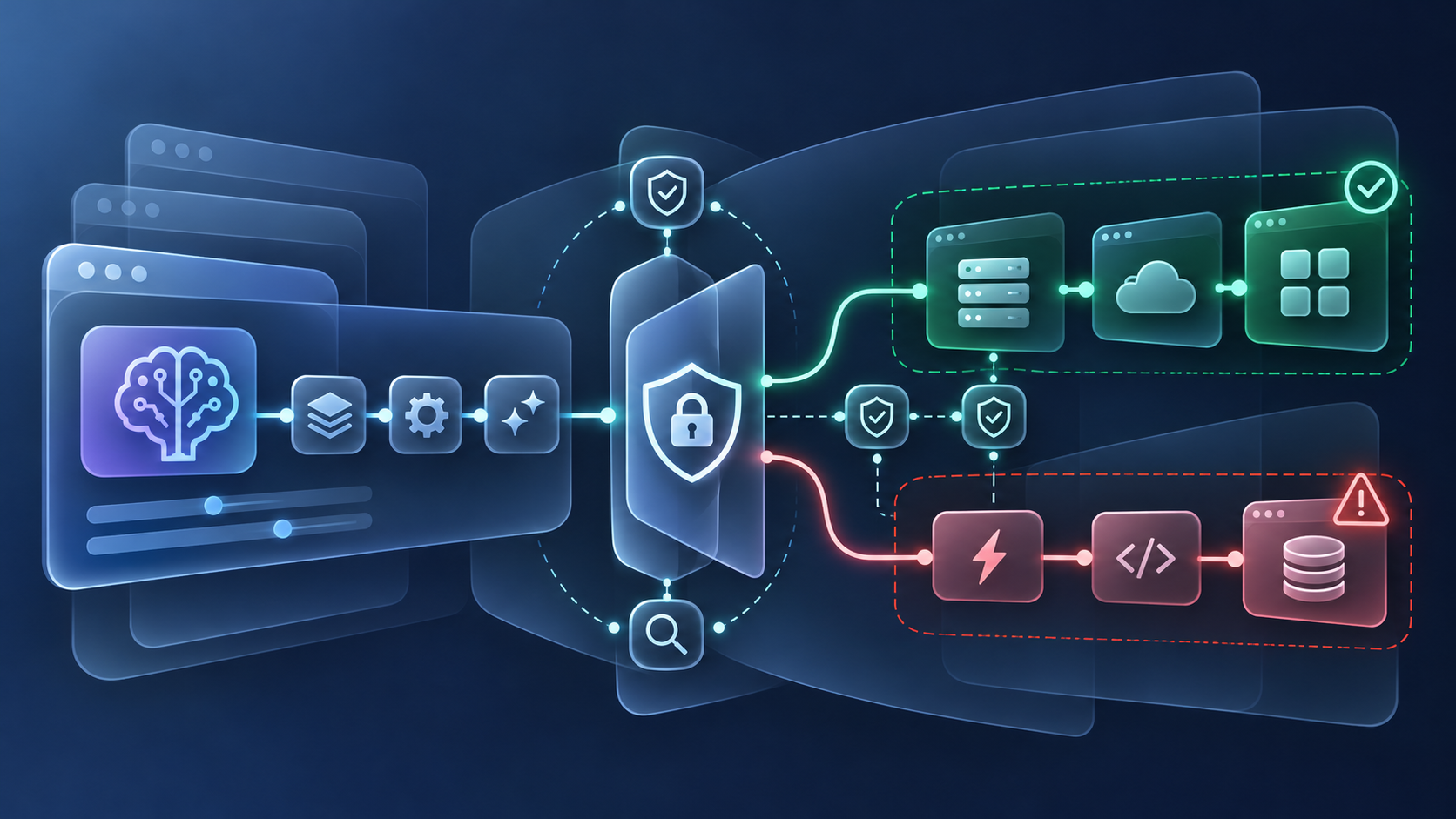
A workflow may coordinate several applications, execute local processes, and interact with external services. Each component introduces its own execution environment, permissions, and security boundaries.
The challenge becomes particularly interesting when an AI-powered workflow delegates operations to applications that already possess broader access than the original task requires.
A restriction enforced at one point in the workflow does not necessarily apply elsewhere, raising an architectural question: how can security guarantees remain meaningful when AI-driven operations cross multiple application and system boundaries?
Answering it requires looking beyond individual integrations and examining the execution architecture as a whole.
When AI Workflows Exceed Their Intended Scope
Consider an AI-powered workflow coordinating inventory updates across a warehouse management system, a logistics platform, and an internal document service.
The workflow is authorized to update shipment information for a specific customer order, but no other orders. It identifies the relevant records, prepares the changes, and delegates execution to the connected applications.
Each integration operates correctly within its available capabilities. Yet one operation modifies inventory records belonging to another order, outside the workflow's authorized scope.
The problem is not necessarily a malfunctioning API or an unauthorized connection. The workflow may have submitted a technically valid request that exceeded the scope of the original task.
This distinction matters because application permissions rarely describe the full context of a business operation. A logistics integration may legitimately support updates across an entire warehouse, while a particular workflow should only affect a specific shipment.
The same issue appears in local AI-assisted development. A coding assistant working inside one repository may execute operations under a user account that can access unrelated projects.
In both cases, the intended workspace or business task is narrower than the authority available to the executing software.
The resulting security question is not simply whether an operation was permitted, but whether its effects remained within the boundaries of the task that initiated it.
When Integrations Amplify Authority
The discrepancy becomes more significant when execution moves beyond the application that initiated the task.
In the logistics scenario, an inventory update is performed by a connected management system using its own capabilities. The workflow does not necessarily possess those capabilities directly. Instead, it invokes another component that does.
This resembles the established confused deputy problem, described by Norm Hardy in 1988: a component with legitimate authority can be induced to exercise that authority in ways that do not reflect the requesting party's intended scope.
AI integrations introduce an interesting variation. The requesting component may dynamically select operations and construct parameters based on model-generated decisions. A technically valid request can therefore produce an unintended effect without either application malfunctioning.
Delegation itself is not a security vulnerability. Applications routinely perform operations on behalf of other systems.
The risk emerges when an integration accepts an operation based on its own available authority without independently establishing whether that operation belongs to the initiating task.
Understanding this mechanism requires examining more than the initiating workflow. The relevant security decision may belong to a component that executes the request with a different set of capabilities.
The Limits of System-Level Restrictions
Operating-system security mechanisms provide an important layer of protection because they can enforce restrictions independently of application behavior. However, their effectiveness depends on which processes and resources fall within those restrictions.
Linux Landlock provides a useful example. It allows processes to impose kernel-enforced restrictions on filesystem operations, including access to specific directory hierarchies. These restrictions can also apply to subsequently created child processes.
A local execution component may therefore be prevented from modifying files outside its assigned workspace. Yet the same workflow could delegate an operation to an independently running document service that is not subject to those restrictions.
The service may successfully execute an operation that the initiating process could not perform directly.
This is not a failure of Landlock. The restriction continues to operate within its defined scope.
Similar questions arise through other execution paths, including application APIs and desktop automation. An operation performed by a connected application is subject to that application's execution context and applicable controls, rather than automatically inheriting the restrictions of the requesting process.
System-level protection must therefore be evaluated against the components actually performing the operations, not merely the process where the workflow begins.
Designing for Controlled Execution
The architectural challenge is deciding where restrictions should be enforced as AI-driven operations move between connected systems.
Current integration platforms offer several approaches, each addressing a different part of the problem.
At the connector level, individual operations can be governed without disabling an entire integration. Microsoft's Power Platform connector action controls demonstrate this approach by allowing administrators to permit or block specific actions. However, restricting an operation does not necessarily constrain which business records it can affect.
Centralized policy enforcement provides another option. Amazon Bedrock AgentCore Gateway supports policy evaluation for MCP tool invocations. Its distinction between LOG_ONLY and ENFORCE modes is particularly relevant: evaluating a policy is not equivalent to enforcing its decision. The gateway becomes a critical architectural boundary for those invocations, provided the workflow cannot bypass it through another execution path.
Application-level controls address more specific requirements. The OpenAI Agents SDK supports tool input guardrails for function-tool calls, allowing applications to validate or reject proposed operations before execution. These guardrails do not cover every tool type, making their execution scope an important architectural consideration.
Custom enforcement components offer another architectural option when existing platforms cannot express the required business constraints. A dedicated service could validate the relationship between a shipment, customer, and warehouse before forwarding an inventory update. This provides control independent of the AI workflow's decision-making, but introduces additional infrastructure and maintenance responsibilities. It also offers limited protection if the workflow can bypass the service.
These mechanisms address different levels of authority. A connector policy might prohibit bulk inventory updates, while application logic or a custom enforcement component verifies that a specific shipment belongs to the intended order.
They are not mutually exclusive, nor does deploying more of them automatically guarantee stronger protection.
The appropriate architecture depends on where each constraint can be expressed and enforced. Connector controls suit operation-level restrictions, while resource-specific business rules may require application-level validation or custom enforcement. System-level restrictions remain relevant when workflows execute local processes. In each case, enforcement must cover the actual execution paths, including any alternatives that could bypass the intended controls.
Conclusion
AI-powered integrations introduce security challenges that cannot be evaluated by examining individual applications in isolation.
The logistics scenario illustrates how a legitimate workflow can produce unintended effects when connected systems exercise authority beyond the task's intended scope.
Operating-system restrictions, connector policies, centralized enforcement, and custom application logic provide different forms of protection. Their effectiveness depends on where operations execute and which component is responsible for enforcing the relevant constraints.
For AI systems engineering, this makes the execution architecture itself a central part of the security model. Its boundaries must be understood, independently enforced where appropriate, and reassessed as integrations evolve.
Ultimately, the security of an AI-powered workflow is determined by what its execution architecture actually permits, not simply by what the workflow was designed to accomplish.